
Every building, compound, and facility in Dubai has a perimeter. The question is not whether to secure it — it is which hardware to use, where to place it, and how to make it work alongside your wider security operation.
Bollards, turnstiles, and barrier gates are the three main categories of physical perimeter security hardware. They look different, work differently, and solve different problems. Using the wrong one in the wrong location creates gaps in your security — or worse, creates friction and disruption for the people who are supposed to move freely through your facility every day.
This guide explains what each type of hardware does, where it is used across Dubai and the UAE, how to choose between them, and how to integrate physical barriers with access control systems and security personnel for a complete perimeter security setup.
Quick Summary
- Bollards protect against vehicle impact — fixed, removable, or automatic
- Turnstiles control pedestrian flow — tripod, flap barrier, full-height, or swing gate
- Barrier gates manage vehicle access at entry points — boom arm, parking, or security grade
- The right hardware depends on your threat level, traffic volume, and the balance between security and user experience
- Hardware alone is not a complete solution — integration with access control systems and security personnel is essential
What Is Perimeter Security and Why Does It Matter in Dubai?
Perimeter security is the first and outermost layer of any physical security plan. It defines the boundary of a protected area and controls what — and who — crosses it. Done well, it stops threats before they reach your building, your people, or your assets.
In Dubai, perimeter security hardware matters for several reasons specific to the local environment:
High vehicle density. Dubai has one of the highest vehicle ownership rates in the world. Parking pressure, delivery traffic, and unauthorized vehicle access are daily management challenges at nearly every commercial and residential facility.
Large-scale construction and development. Dubai’s continuous development means that construction sites — with their shifting perimeters, multiple contractor access points, and high-value equipment — are one of the most demanding perimeter security environments in the region.
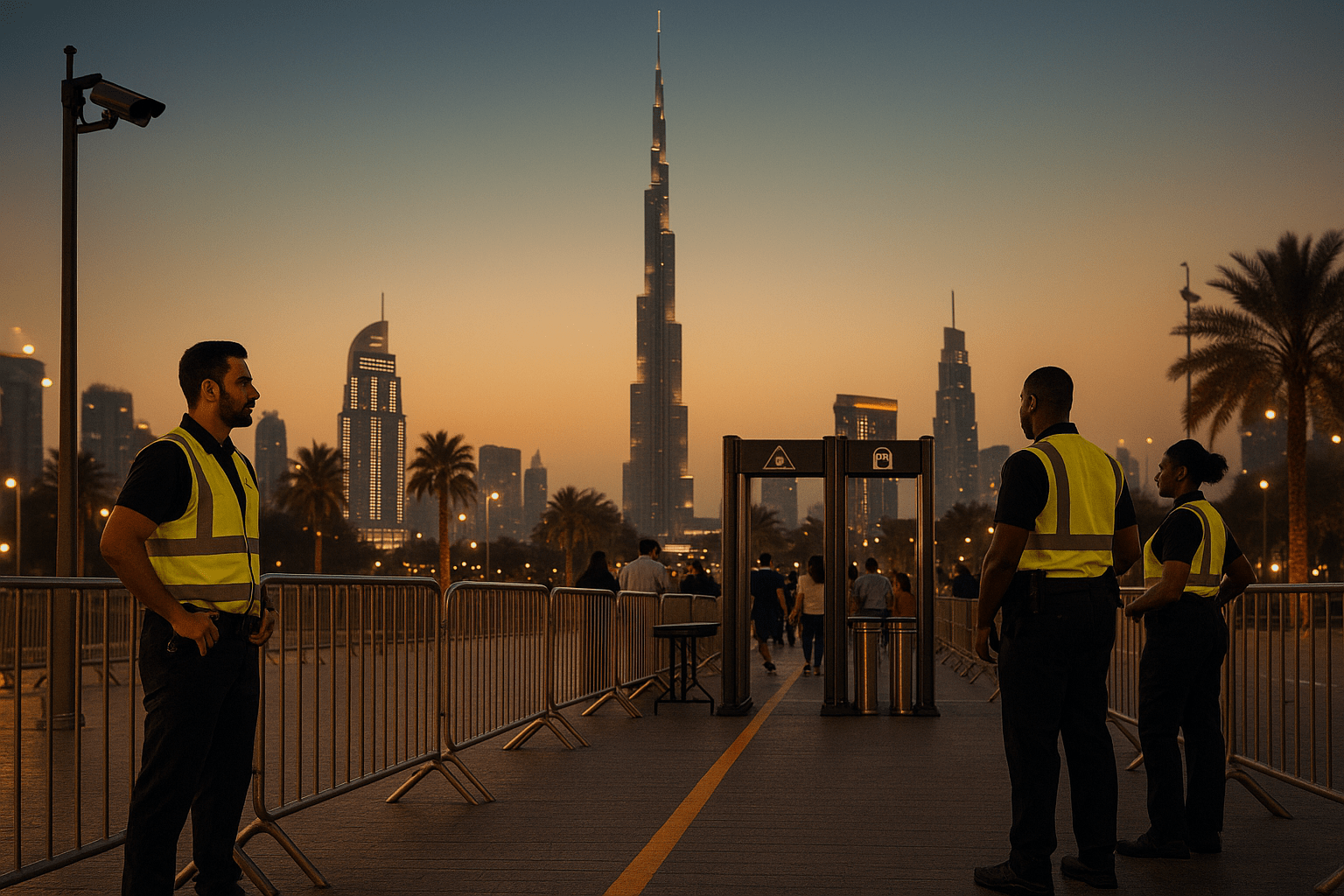
Major events and public gatherings. Dubai hosts hundreds of large-scale events annually at venues across the city. Temporary perimeter security hardware — barriers, bollards, and turnstiles — is a standard part of any event security plan.
High-value assets and sensitive facilities. From DIFC’s financial institutions to data centres, luxury residential compounds, and government facilities, Dubai has a high concentration of sites where perimeter breach carries serious consequences.
Terror and vehicle threat awareness. Vehicle-as-weapon incidents at public spaces globally have made impact-rated perimeter protection a consideration for high-footfall areas and crowded venues — including in the UAE.
Getting perimeter security right means choosing the right hardware for each access point, integrating it with your access control and surveillance systems, and backing it with trained personnel who can manage what the hardware cannot.
Bollards: Types, Uses, and When You Need Them
A bollard is a short, sturdy vertical post installed at the perimeter of a facility or along a pedestrian zone to prevent vehicle access. Bollards are the primary tool for protecting people and buildings against vehicle impact — whether accidental or deliberate.
Types of Bollards
Fixed bollards Permanently installed into the ground. They provide maximum impact resistance and are used where vehicle access is never required — pedestrian plazas, building frontages, storefronts, and public spaces. Fixed bollards are the most cost-effective option where the location does not need to change.
Removable bollards Installed with a ground socket that allows them to be lifted out and replaced as needed. Used where occasional vehicle access is required — event setup and breakdown areas, emergency vehicle lanes, loading zones used outside business hours. Removable bollards provide the security of a fixed bollard with operational flexibility.
Automatic / retractable bollards Motor-driven bollards that rise and lower on command — via keypad, card reader, remote control, or integrated access control system. Used at controlled entry points where authorized vehicles need access but unauthorized vehicles must be stopped. Automatic bollards are common at hotel driveways, corporate campus entrances, and government building access points in Dubai.
Safety bollards Lower-impact bollards used for traffic guidance rather than security — marking pedestrian crossings, directing traffic flow, protecting street furniture. Safety bollards are not rated for vehicle impact resistance.
Bollard Impact Ratings
For security applications, bollard impact ratings matter. The PAS 68 standard (UK) and ASTM F2656 standard (US/international) rate bollards by their ability to stop a vehicle of a given weight at a given speed. In high-threat environments — government buildings, financial institutions, crowded public areas — the bollard specification should be matched to the assessed vehicle threat.
When Do You Need Bollards?
| Situation | Bollard Type | Reason |
|---|---|---|
| Pedestrian plaza or walkway | Fixed | Permanent vehicle exclusion |
| Building frontage on a busy road | Fixed or automatic | Impact protection for occupants |
| Event venue perimeter | Removable | Temporary protection, easy to reposition |
| Hotel or corporate driveway | Automatic retractable | Authorized vehicle access with security control |
| Loading bay used outside hours | Removable | Flexible access control |
| Construction site perimeter | Fixed or removable | Site boundary definition and vehicle control |
Turnstile Gates: Types, Uses, and When You Need Them
A turnstile gate is a physical barrier that controls pedestrian flow — allowing one person through per authorized access event and preventing tailgating (multiple people passing on a single credential). Turnstiles are the standard solution for high-footfall entry points where both security and throughput matter.
Types of Turnstile Gates
Tripod turnstile The most basic and cost-effective turnstile type. Three rotating arms extend horizontally at waist height — one person passes per rotation. Compact, reliable, and widely used at secondary access points, parking facility pedestrian entrances, and lower-security facilities.
Flap barrier gate (speed gate) Retractable flap panels that open to allow one authorized person through, then close immediately. Faster than a tripod turnstile, sleeker in appearance, and widely used in corporate lobbies, DIFC offices, hotels, and high-end commercial facilities. The flap barrier has become the standard in Dubai’s premium commercial environment.
Full-height turnstile Floor-to-ceiling rotating barrier that provides maximum physical restriction — cannot be climbed over or ducked under. Used at high-security perimeters, construction sites, prisons, military facilities, and industrial zones where forced entry prevention is the priority rather than guest experience.
Swing barrier gate A single or double swinging panel, often used for accessibility — providing a wider lane for wheelchair users, pushchairs, or people with large items. Typically used alongside a standard flap barrier installation to provide an accessible alternative without compromising the main security lane.
Turnstile Gates in Dubai
Turnstile gates Dubai installations are concentrated in several environments:
- Corporate towers in DIFC, Business Bay, and JLT — flap barrier systems are the standard for lobby access control
- Metro and transport hubs — high-volume tripod or full-height turnstiles
- Construction sites — full-height turnstiles at main worker entry points for headcount management and credentialing
- Events — temporary tripod or flap barrier installations for ticket verification at concerts, exhibitions, and sporting events
- Industrial facilities — full-height turnstiles at perimeter gates for shift-change management
Turnstile Selection Guide
| Environment | Recommended Type | Key Reason |
|---|---|---|
| Corporate lobby (premium) | Flap barrier / speed gate | Throughput + aesthetics |
| Construction site | Full-height turnstile | Forced entry prevention |
| Event venue (temporary) | Tripod turnstile | Cost, portability, speed |
| Industrial facility | Full-height turnstile | Maximum restriction |
| Mixed-use with accessibility needs | Swing barrier alongside flap barrier | Inclusive access |
| Secondary or service entrance | Tripod turnstile | Cost-effective control |
Barrier Gates: Types, Uses, and When You Need Them
A barrier gate — also called a gate barrier or boom gate — is a horizontal arm that rises and lowers to control vehicle access at a specific point. It is the most common form of vehicle access control at car parks, compounds, and facility entrances across Dubai.
Types of Barrier Gates
Standard boom arm barrier gate The most common type — a counterbalanced arm that rises to allow vehicle passage and lowers to block access. Available in arm lengths from 1 metre to 6 metres for wider lanes. Used at car parks, residential compounds, office building entrances, and industrial sites.
Parking barrier gate A compact boom gate optimized for parking facility use — fast cycle time, high durability for high-frequency operation, and often integrated with ticket machines, RFID readers, or license plate recognition cameras. The parking barrier gate is the standard solution for multi-storey car parks and surface parking across Dubai.
Automatic gate barrier Any barrier gate with motorized operation — the standard in modern Dubai installations. Controlled via remote, keypad, RFID card, or integrated access control system. Most barrier gates installed in Dubai today are automatic.
Security barrier gate Heavy-duty barrier gates built to resist forced entry — reinforced arm, strengthened mechanism, and sometimes combined with ground-level tire spikes or bollards for additional vehicle stopping power. Used at high-security entry points where a standard boom gate does not provide sufficient resistance.
Flap barrier gate As covered in the turnstile section — a pedestrian-specific barrier that is sometimes categorized under barrier gates due to its physical gate mechanism. Not for vehicle use.
Key Brands and Systems
Several barrier gate brands are widely used in Dubai and the UAE:
- CAME gate barrier — Italian manufacturer with strong presence in UAE commercial and residential installations. The CAME gate barrier range covers standard boom gates through to high-security variants
- BFT gate barrier — another Italian brand widely distributed in the UAE. BFT gate barrier systems are common in residential compounds and corporate facilities
- Nice gate barrier — Nice is a well-established European automation brand. Nice gate barrier systems are used across parking and access control applications in the UAE
- Hikvision access control — while primarily an access control and CCTV brand, Hikvision integrates with barrier gate systems for full vehicle access management
When choosing a brand, the key factors are not the name but the availability of local service and spare parts, the warranty terms, and the integration capability with your access control and CCTV systems. A gate barrier system in Dubai that breaks down and cannot be serviced locally within 24–48 hours is a serious operational problem.
Barrier Gate Selection Guide
| Application | Gate Type | Key Requirement |
|---|---|---|
| Multi-storey car park | Parking barrier gate | High cycle count durability |
| Residential compound | Automatic boom gate | Reliability + remote management |
| Corporate campus entry | Automatic boom gate + RFID | Access control integration |
| Industrial facility | Security barrier gate | Forced entry resistance |
| Event venue (temporary) | Portable barrier gate | Rapid deployment and removal |
| High-security perimeter | Security gate + bollards | Combined vehicle stopping power |
Bollards vs. Barrier Gates vs. Turnstiles: How to Choose
The most common source of confusion in perimeter security planning is which hardware to use at which point. Here is a direct comparison:
| Bollards | Barrier Gates | Turnstiles | |
|---|---|---|---|
| Controls | Vehicles | Vehicles | Pedestrians |
| Stops forced entry | Yes (fixed/automatic) | Limited | No (except full-height) |
| Allows authorized access | Only removable/automatic | Yes | Yes |
| Throughput | N/A | Medium–High (per lane) | Medium–High (per lane) |
| Credential integration | Automatic bollards only | Yes | Yes |
| Cost range | Low (fixed) to High (automatic) | Medium to High | Low to High |
| Best for | Impact protection, pedestrian zones | Vehicle entry management | Pedestrian entry management |
The decision framework:
- If you need to stop vehicles from reaching a building or pedestrian area → bollards
- If you need to control which vehicles enter a site or car park → barrier gate system
- If you need to control pedestrian flow and prevent tailgating → turnstile
- If you need both vehicle and pedestrian control at the same entrance → barrier gate + turnstile in separate lanes, or a combined gate barrier system with pedestrian gate
Most professional perimeter security setups in Dubai use all three — bollards at the building frontage or pedestrian areas, barrier gates at vehicle entry points, and turnstiles at pedestrian access points. They are complementary, not interchangeable.
Gate Barrier Systems in Dubai: What to Know Before You Buy
The gate barrier system market in Dubai is active and competitive. There are dozens of suppliers offering everything from budget boom gates to full integrated security systems. Here is what to focus on before you buy:
Local Support and Service
A gate barrier system that breaks down is a security gap and an operational disruption. Before committing to any supplier, confirm:
- Is there a local service team in Dubai or across the UAE?
- What is the typical response time for a breakdown call?
- Are spare parts held locally or imported on demand?
- What does the warranty cover and for how long?
Gate barrier system suppliers in Dubai vary significantly on these points. A supplier with a local engineering team and spare parts held in-country is worth more than a cheaper option that sources everything from overseas.
Integration Capability
A standalone barrier gate that cannot talk to your access control system, CCTV, or management platform is a limited solution. Modern gate barrier systems in Dubai should integrate with:
- RFID card readers and access control databases
- License plate recognition (LPR) cameras
- Parking management software
- CCTV and video surveillance platforms
- Intercom and remote monitoring systems
For businesses looking at a full access control system setup, the barrier gate is one component in a larger integrated system — not a standalone purchase.
Gate Barrier System Installation
Gate barrier system installation in Dubai requires:
- Civil works for ground foundation and cable ducting
- Electrical supply to the barrier mechanism and control equipment
- Network connection for system integration
- Testing and commissioning of the full system including credential integration
- Staff training on manual override procedures
Always have the installation carried out by a certified team. Incorrect installation is the primary cause of early mechanical failure and integration problems in gate barrier systems across the UAE.
Automatic Gate Barrier Systems: Features and Benefits
Automatic gate barrier systems are the standard in Dubai’s commercial and residential market. The manual alternative — a guard physically lifting and lowering a barrier arm — is slow, prone to human error, and expensive for high-frequency access points.
Key features of a modern automatic gate barrier system:
Multiple credential options
- RFID transponders in vehicles (common for regular users in residential and corporate settings)
- Keypad entry for visitors
- License plate recognition for high-throughput car parks
- Remote control for residential compound management
- Intercom with video for visitor verification
Speed settings Barrier arm opening and closing speed is configurable. High-traffic car parks need fast cycle times. Security-sensitive entry points benefit from a slower, more deliberate operation that gives security staff time to observe each vehicle.
Safety features Modern automatic gate barriers include vehicle detection loops in the ground — the arm will not close while a vehicle is detected beneath it. Anti-crush safety sensors prevent the arm from descending onto a vehicle that has stopped mid-passage.
Remote monitoring and management Cloud-connected gate barrier systems allow facility managers to monitor access events, control the barrier remotely, and receive alerts for technical faults or forced entry attempts.
Backup power In the event of a power failure, automatic gate barriers should have a backup power supply or battery system that maintains operation for a defined period. For security-critical sites, this is non-negotiable.
Barrier Gate Access Control System Integration
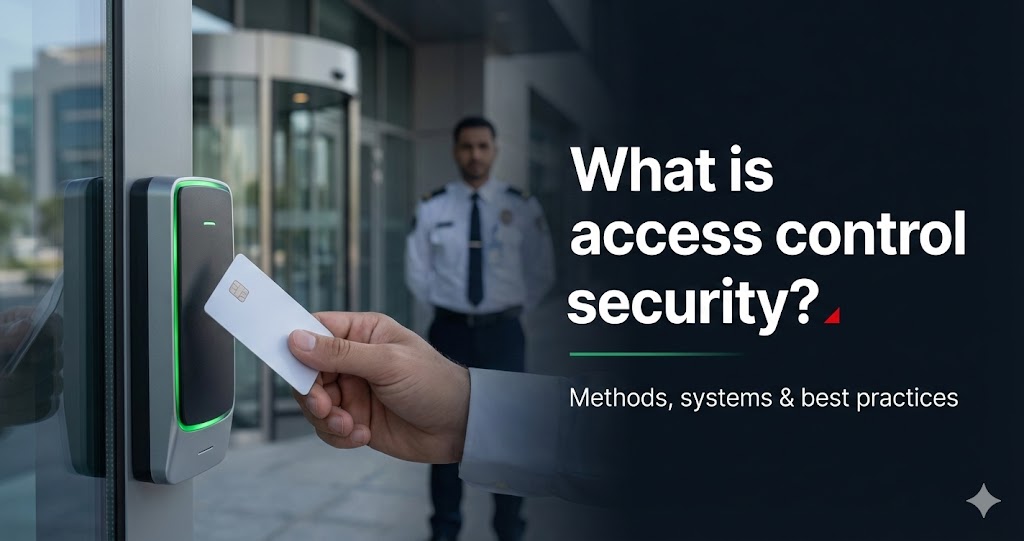
The real value of a modern gate barrier system comes from its integration with your broader access control system. Here is how a fully integrated barrier gate access control system works in practice:
Scenario: Corporate campus in Dubai
- An employee arrives at the vehicle gate and presents their RFID transponder
- The access control system checks the transponder against the database — the employee is authorized for vehicle access
- The barrier gate rises automatically — the employee drives through
- The access event is logged: employee name, vehicle, time, gate location
- The barrier gate closes behind the vehicle
- CCTV footage from the gate camera is automatically linked to the access log entry
Scenario: Unauthorized vehicle
- An unknown vehicle approaches the gate
- No valid RFID transponder — the barrier does not open
- The vehicle interacts with the intercom — the guard reviews the CCTV feed and speaks to the driver
- The guard determines the vehicle is not authorized and denies access
- The attempt is logged with CCTV footage attached
This integration — barrier gate, RFID, access control database, CCTV, and guard oversight — is the complete system. Any one of these elements working alone is less effective than all of them working together.
For construction sites, the integration extends to worker credentialing and headcount management — ensuring only workers with valid inductions on site can enter through the construction site security framework.
Perimeter Security for Different Facility Types in Dubai
Corporate Offices and Business Parks
Corporate facilities in Dubai — particularly in DIFC, Business Bay, JLT, and DWTC — need perimeter security that combines strong access control with a professional, welcoming appearance. The typical setup:
- Vehicle entry: automatic boom gate with RFID or license plate recognition
- Pedestrian entry: flap barrier speed gate in the lobby, integrated with access control
- Building frontage: fixed or automatic bollards protecting the entrance from vehicle impact
- Visitor management: intercom at gate with CCTV and guard verification
Residential Compounds and Towers
Residential security in Dubai needs to balance strict access control with resident comfort — gates that are too slow or too demanding create friction that residents resent.
- Vehicle entry: automatic boom gate with RFID transponders for residents, intercom for visitors
- Pedestrian entry: turnstile or controlled door with card access
- Perimeter: boundary fencing or wall, with lighting and CCTV
- Porter or concierge: human layer managing visitor registration and delivery — porter services are the standard in high-end residential buildings
Construction Sites
Construction site perimeter security in Dubai must manage a constantly changing workforce, multiple contractor types, delivery vehicles, and restricted zones within the site.
- Main entry: full-height turnstile for workers with biometric credentialing
- Vehicle gate: heavy-duty automatic boom gate with guard verification
- Perimeter: hoarding or fencing, monitored by CCTV and regular patrol
- Restricted zones: secondary barriers within the site for high-risk or high-value areas
Construction site security services that combine hardware with trained security personnel deliver the strongest result in this environment.
Events and Temporary Venues
Event perimeter security is temporary by nature but must be as effective as any permanent installation during the event period.
- Pedestrian entry: tripod turnstiles or flap barriers at ticket check points
- Vehicle access: portable barrier gates for event crew, artist, and emergency vehicle access
- Crowd control: water-filled barriers, fencing, and bollards to define the event perimeter and pedestrian routes
- Coordination: event security personnel managing all entry points, coordinated with event security services
Warehouses and Industrial Facilities
Industrial perimeter security in Dubai’s logistics zones — Jebel Ali, Dubai South, DIP — must manage high volumes of heavy goods vehicles, shift-change pedestrian traffic, and restricted zones within large sites.
- Main vehicle gate: heavy-duty automatic boom gate, long arm for wide vehicle lanes
- Pedestrian entry: full-height turnstile with biometric credentialing
- Inner zones: secondary boom gates or barriers controlling access to high-value storage or hazardous areas
- Perimeter surveillance: CCTV coverage of the full boundary, supplemented by night surveillance for after-hours coverage
Hotels and Hospitality Venues
Hotels in Dubai need perimeter security that is invisible to the guest experience while maintaining real control.
- Vehicle driveway: automatic retractable bollards for impact protection, with a boom gate managing the drop-off zone
- Pedestrian entrance: no visible turnstile — door security staff manage the entry with a professional, guest-facing approach
- Parking: parking barrier gate system integrated with hotel management software
- Event space perimeter: temporary barrier setup for hotel-hosted events, coordinated with the event security team
Common Mistakes in Perimeter Security Hardware Selection
1. Choosing bollards that are not impact-rated for the threat A decorative bollard or a safety bollard will not stop a vehicle. If impact protection is the goal, specify bollards that are rated to the appropriate standard for your threat level. Appearance and security rating are separate considerations.
2. Installing a barrier gate without anti-tailgate measures A single boom gate arm stops one vehicle. A determined driver in a second vehicle can follow immediately behind an authorized one. For high-security sites, a second gate arm, a security guard, or vehicle detection technology that prevents follow-through is essential.
3. Selecting turnstiles on aesthetics alone A flap barrier in a construction site is the wrong choice — it will be damaged quickly and offers insufficient restriction. A full-height turnstile in a premium hotel lobby is also wrong — it creates a negative impression. Match the turnstile type to the environment and the threat level.
4. Ignoring maintenance requirements Automatic bollards, barrier gates, and turnstiles are electromechanical systems. They require regular maintenance — lubrication, motor checks, sensor testing, and software updates. A maintenance contract should be built into any hardware purchase for the UAE’s heat and dust environment.
5. Not planning for emergency access Every perimeter security installation needs a defined emergency access procedure. Automatic bollards must have a manual lowering mechanism. Barrier gates must have a manual override. Full-height turnstiles need a fail-safe release for evacuation. These procedures must be documented and tested.
6. Treating hardware as a standalone solution No bollard, turnstile, or barrier gate is effective without the right human support and system integration. Hardware defines the perimeter. Guards manage it. Access control systems verify credentials. CCTV records events. All four elements are needed.
PSM UAE: Traffic Control and Perimeter Security Services
PSM UAE is a SIRA-licensed security company with over 14 years of experience providing traffic control services and perimeter security management across Dubai, Abu Dhabi, and the wider UAE.
PSM provides the human layer that makes perimeter security hardware work — trained traffic control officers and security guards who manage vehicle and pedestrian flow, verify credentials, respond to access attempts, and coordinate with your gate barrier system and CCTV infrastructure.
PSM’s perimeter security and traffic control services cover:
- Corporate campuses and business parks — gate management, visitor verification, and vehicle access control
- Construction sites — worker entry management, contractor credentialing, and vehicle gate control in coordination with construction site security
- Events and festivals — temporary entry management, crowd flow control, and vehicle access coordination alongside event security services
- Residential compounds — resident and visitor access management at vehicle and pedestrian gates
- Industrial facilities — shift-change management, delivery vehicle control, and perimeter patrol
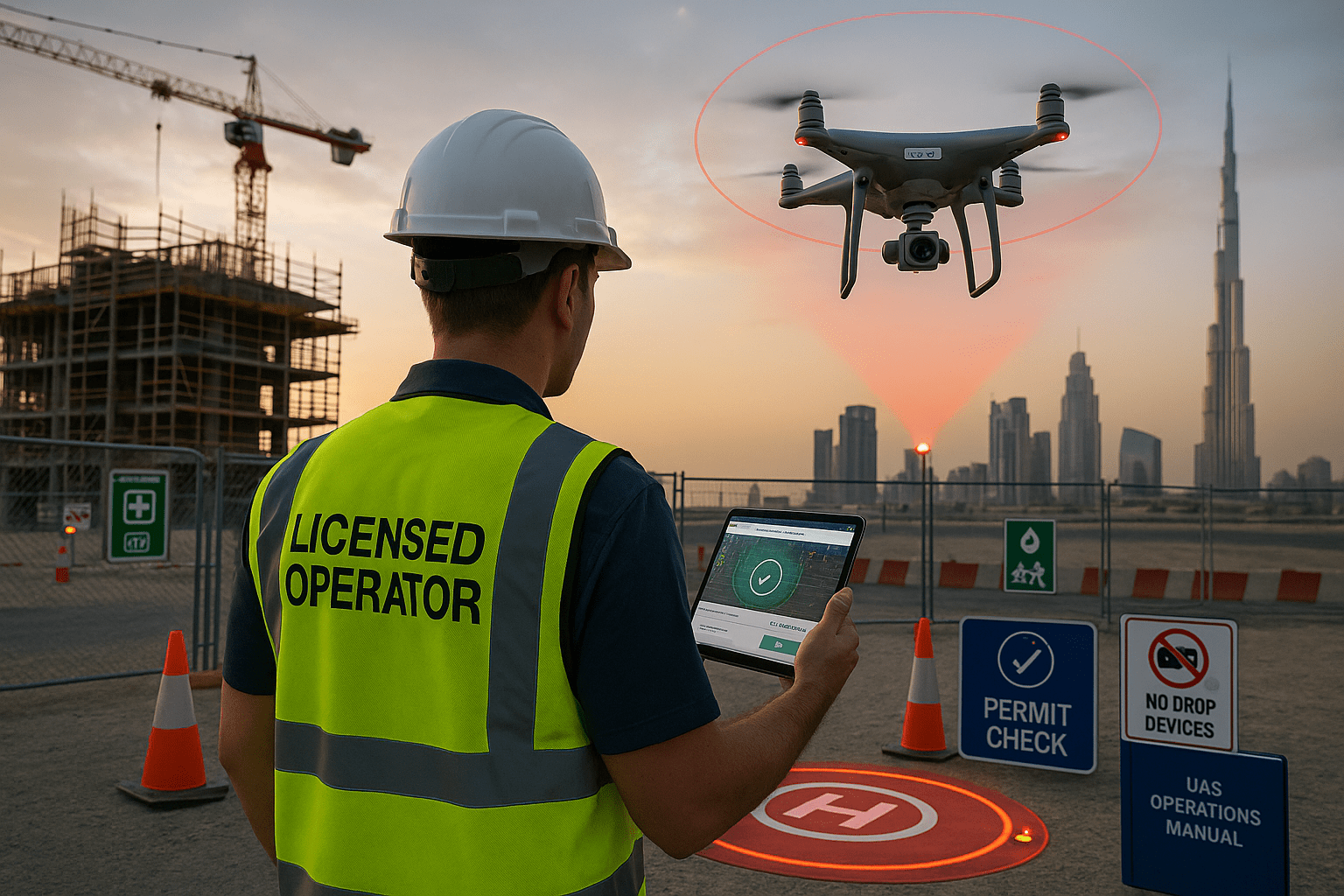
For facilities that also require after-hours coverage, night surveillance services extend perimeter security beyond the hours when traffic control officers are deployed. For larger outdoor perimeters, drone surveillance provides aerial monitoring of boundary areas that would require many guards on foot to cover.
The combination of PSM’s security personnel, your gate barrier system, your access control infrastructure, and your CCTV setup creates a layered perimeter security operation where each element supports the others.
Key Takeaways: Perimeter Security in Dubai
Before specifying any perimeter security hardware for your Dubai facility:
- Map every access point — vehicle and pedestrian, primary and secondary, permanent and temporary
- Match hardware to the threat — bollards for vehicle impact protection, barrier gates for vehicle access control, turnstiles for pedestrian control
- Never rely on hardware alone — integrate with access control systems, CCTV, and trained security personnel
- Check impact ratings for bollards — decorative and safety bollards are not the same as security-rated bollards
- Plan for tailgating — especially at turnstile and boom gate installations
- Confirm local service capability — gate barrier system suppliers in Dubai and UAE who can service your equipment quickly are worth the investment
- Build in emergency procedures — every perimeter installation needs a documented and tested emergency access plan
- Maintain the hardware — automatic systems in Dubai’s climate require regular maintenance to remain reliable
Frequently Asked Questions About Perimeter Security in Dubai
What is the difference between a bollard and a barrier gate?
A bollard is a fixed or automatic vertical post that prevents vehicles from entering a specific area — it provides impact protection. A barrier gate is a horizontal boom arm that rises and lowers to control vehicle access at an entry point — it manages authorized vehicle flow. Both control vehicles, but in different ways and for different purposes.
What type of turnstile is best for a Dubai corporate office?
A flap barrier gate (speed gate) is the standard in Dubai’s corporate market — fast, sleek, and effective at preventing tailgating in a high-footfall lobby environment. Full-height turnstiles are used where maximum physical restriction is needed, but they are not suitable for a premium corporate environment.
How does an automatic gate barrier system work?
An automatic gate barrier rises when a valid credential is presented — RFID card, transponder, license plate recognition, or intercom release. The arm lowers after the vehicle has passed. Modern systems include vehicle detection loops that prevent the arm from closing on a vehicle, and can be monitored and controlled remotely.
What are CAME, BFT, and Nice gate barriers?
CAME, BFT, and Nice are European automation manufacturers whose gate barrier products are widely distributed in Dubai and the UAE. All three offer barrier gate systems ranging from standard boom gates to high-security models. The choice between them typically comes down to local service availability and integration compatibility with your access control system.
Do I need a security guard at my barrier gate?
For most commercial and residential applications, an automatic gate barrier with RFID or license plate recognition can manage routine access without a guard present. For higher-security sites, or where visitor verification requires human judgement, a guard at the gate adds a layer that technology alone cannot provide.
What is a flap barrier gate?
A flap barrier gate — also called a speed gate — is a retractable panel barrier used for pedestrian access control. It opens to allow one authorized person through and closes immediately to prevent the next person from following without a valid credential. It is the standard pedestrian access control solution in Dubai’s corporate buildings and hotels.
Can barrier gates be integrated with access control systems?
Yes — and they should be. A barrier gate integrated with an RFID access control system, a license plate recognition camera, and a CCTV platform creates a complete vehicle access management system. Every access event is logged, credential-verified, and recorded on camera.
What is the difference between removable and automatic bollards?
Removable bollards are lifted manually from a ground socket when vehicle access is needed — they offer the security of a fixed bollard with operational flexibility but require manual intervention. Automatic retractable bollards are motor-driven and can be lowered and raised on command via a remote or access control credential — they are faster and more convenient but have higher installation and maintenance costs.