
Access control in security is the process of managing and restricting who can enter, move through, or exit a specific location. It uses trained security guards, electronic systems, and clearly written policies to make sure only authorised people can get into protected areas.
A building can have the best CCTV cameras money can buy, a 24-hour control room, and motion sensors on every floor. But if anyone can walk through the front door without being checked — none of that matters. Access control sits at the front of every other security measure. Get it wrong, and everything else becomes harder.
In the UAE, this matters more than most places. Dubai and Abu Dhabi are home to high-value commercial properties, busy business districts, and large-scale events. Free zones like DIFC and JAFZA house hundreds of international companies with sensitive data and valuable assets. Residential compounds host thousands of families. In environments like these, access control security is not optional — it is foundational.
Why Is Access Control the Foundation of Physical Security?
Access control is the first and most important layer of any security plan — because once an unauthorised person is inside a facility, every other security measure shifts from prevention to reaction.
When access control fails, problems multiply fast. Your cameras are recording instead of preventing. Your guards are reacting instead of stopping. The damage is already being done.
Key benefits of proper access control:
- Prevention of theft and unauthorised entry
- Protection of employees, tenants, and visitors
- Safeguarding of assets and confidential information
- Regulatory compliance with SIRA requirements in Dubai
- Reduction of legal liability
- Creation of accurate audit trails for incident investigation
The cost of getting it wrong is higher than most businesses realise. Direct costs include theft, data breaches, and property damage. Indirect costs include legal liability, reputational damage, and staff turnover driven by employees who feel unsafe. A 2023 Allied Market Research report valued the global access control market at over $10 billion USD, with the Middle East and Africa identified as one of the fastest-growing regions.
How Does Access Control Work? The AAA Framework
Access control works through four structured steps — Identification, Authentication, Authorisation, and Accountability. Together, these four steps form the backbone of every access control security operation.
1. Identification — Who Are You?
A person arrives and presents some form of ID — an Emirates ID, a company badge, a visitor pass, or a biometric profile. The guard or system asks: who are you claiming to be?
2. Authentication — Can You Prove It?
This is the verification step. The guard checks that the photo matches, the credentials are valid, and the document belongs to the person presenting it. Electronic systems do this via fingerprint matching or RFID card reading.
3. Authorisation — Are You Allowed Here?
Passing identification does not mean access everywhere. Different people have different access levels:
| Access Level | Example | Areas Permitted |
|---|---|---|
| General staff | Office employees | Common areas, own floor |
| Management | Senior executives | Management suites, board rooms |
| Contractors | Maintenance workers | Specific work areas only |
| Visitors | Clients, guests | Reception, meeting rooms |
| Security personnel | Guards | All monitored areas |
4. Accountability — What Happened and When?
Every entry, exit, failed access attempt, and visitor movement is logged. This documentation protects the business during incident investigations, regulatory audits, and legal disputes.
What Are the Types of Access Control in Security?
There are five main types of access control systems, each suited to different environments and risk levels.
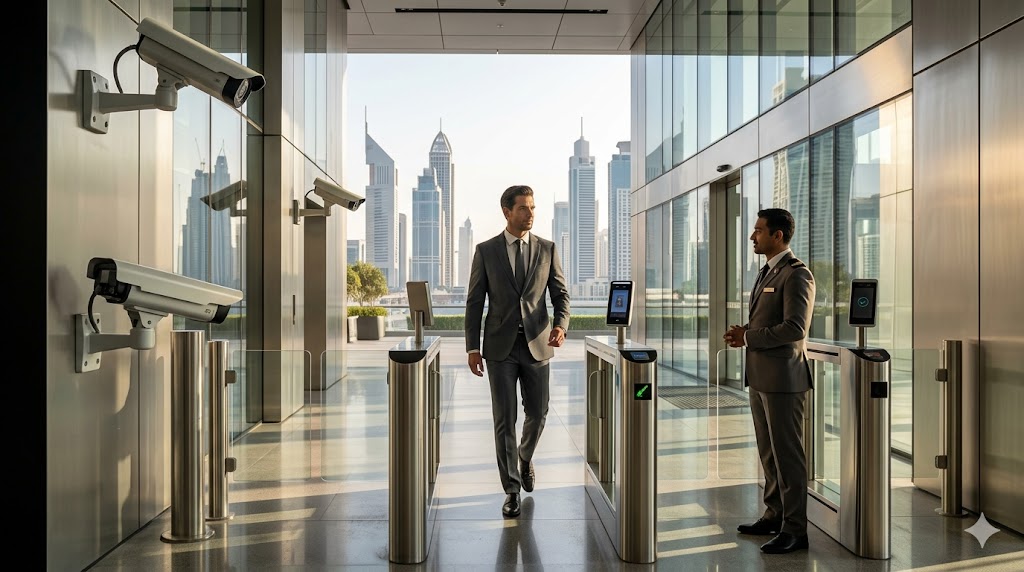
Physical access control uses barriers, manned checkpoints, turnstiles, and boom gates. It is standard at residential compounds, industrial zones, and construction sites. A trained guard makes real-time judgements that no electronic system can replicate.
Electronic access control uses RFID keycards, PIN keypads, intercom systems, and automated barriers. It is fast, scalable, and generates automatic logs — but works best when supported by a guard.
Biometric access control uses fingerprint scanning, facial recognition, or iris scanning. It is the most secure method available because biometric data cannot be shared or borrowed. Standard in UAE government buildings, data centres, and financial institutions.
Mobile access control uses smartphones, QR codes, and Bluetooth credentials. Useful for events and flexible workspaces where physical badges are impractical.
Hybrid access control combines two or more of the above. This is the strongest approach and the standard for high-security environments across the UAE.
| Type | Security Level | Best For | Guard Required? |
|---|---|---|---|
| Manual | Medium | All sites, high-risk environments | Yes |
| Electronic (Keycard) | Medium–High | Offices, car parks, retail | Recommended |
| Biometric | Very High | Data centres, banks, government | Recommended |
| Mobile | Medium–High | Events, flexible workspaces | Optional |
| Hybrid | Highest | All high-security environments | Yes |
What Do Security Guards Do in Access Control?
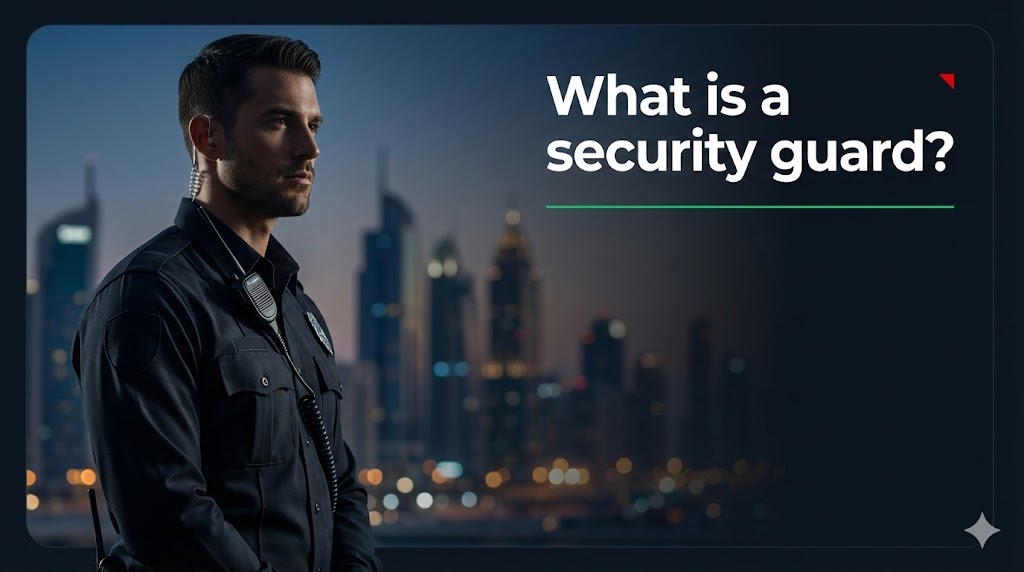
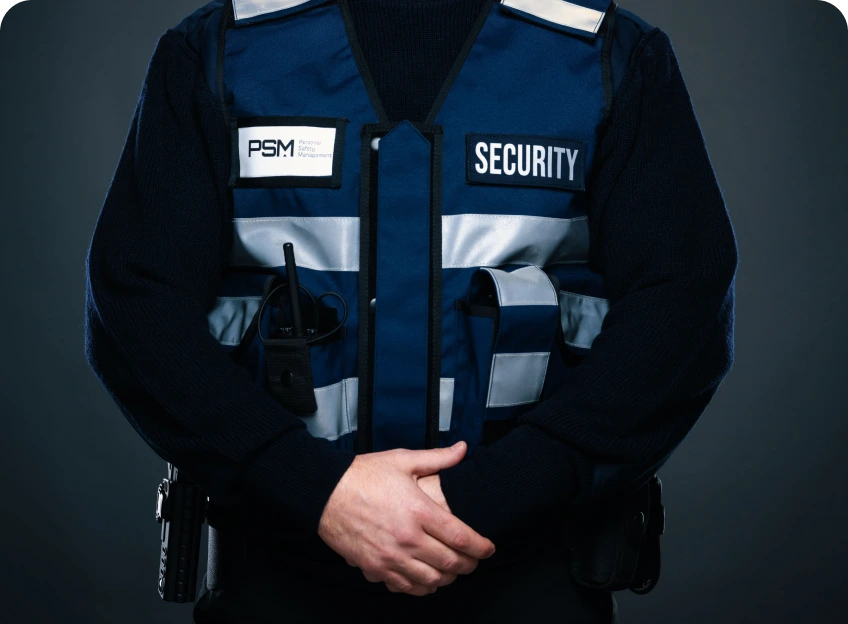
Security guards are the human decision-makers at the front line of access control — and they do things no technology can. They read situations, de-escalate confrontations, respond to emergencies, and exercise judgement when credentials look valid but something feels wrong.
For professional access control services in the UAE, the quality of the security guard is not a secondary consideration — it is the primary one.
Core duties of an access control security guard:
- Manning and monitoring all entry and exit points
- Verifying identity documents and access credentials
- Cross-checking visitors against pre-approved lists
- Issuing and collecting visitor passes
- Operating electronic access systems and CCTV controls
- Conducting bag and vehicle checks where required
- Maintaining accurate entry and exit logs
- Reporting and responding to security incidents in real time
What guards do that technology cannot:
A person arrives with a valid keycard. The system opens the door. But the guard notices the uniform does not match the company on the ID, and the bag seems heavier than the listed tools. The guard asks questions. The person cannot answer. Entry is denied.
An electronic system would have let that person straight through.
For high-risk environments where the stakes are highest, armed security services provide an additional level of deterrence beyond standard access control.
Access Control Across Different Sites in the UAE
Residential buildings and compounds — Guards verify residents, log visitors, check deliveries, and manage contractor access. Property protection services provide structured 24/7 access management for residential environments.
Construction sites — A constantly changing roster of contractors, suppliers, and inspectors makes access control complex. Unauthorised access is both a security and a safety risk. Construction site security covers worker credentialing, restricted zone enforcement, and delivery management.
Events — Multiple entry points, tiered access levels, time pressure, and large crowds make events one of the most demanding access control environments. Event security services must be planned in detail before the first guest arrives.
Door and entrance security — At hotels, restaurants, and entertainment venues, door security guards enforce entry criteria while managing a customer-facing environment. Door security services require guards who combine firm access control with strong interpersonal skills.
How Do Guards and Technology Work Together?
The strongest access control security operations combine technology for speed and data with guards for judgement and response. Neither replaces the other.
CCTV integration — Guards monitoring live feeds can spot suspicious behaviour before it reaches a checkpoint and respond to incidents the moment they begin. 24/7 night surveillance is particularly important, as overnight hours are when facilities are most vulnerable.
Visitor management systems — Digital platforms replace paper sign-in books with live visitor records, automatic badge printing, and real-time occupancy data. Guards operate these systems as part of their access control role.
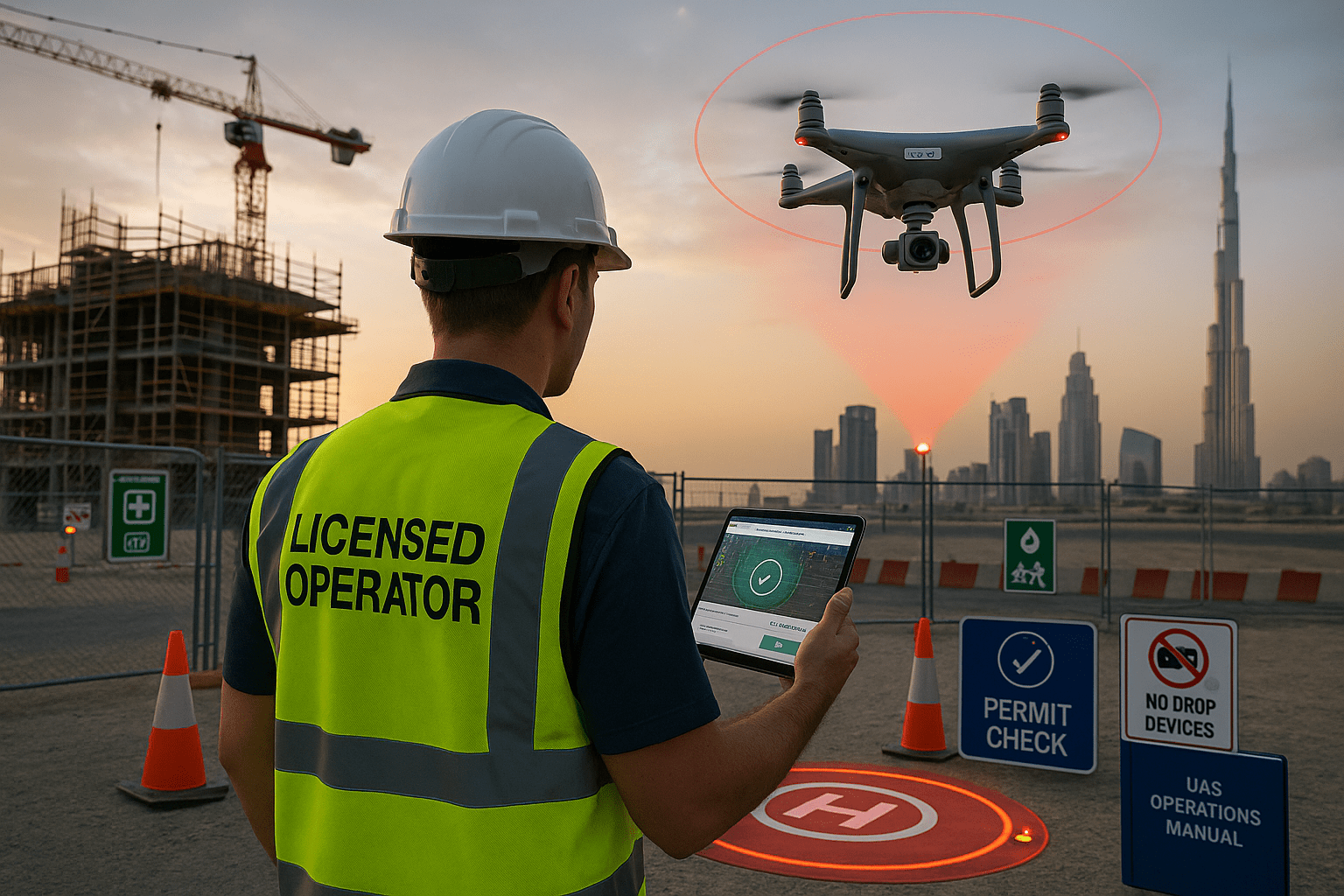
Drone surveillance — For large sites with extensive perimeters, drones patrol areas that would require many guards on foot, transmitting live footage to a control room. Drone surveillance solutions work best as part of a wider access control plan.
Vehicle access control — Boom barriers, RFID transponders, and license plate recognition cameras manage vehicle entry at compounds, industrial sites, and corporate campuses. Traffic control services often form part of a wider access control operation for large sites.
What Are the Best Practices for Access Control in the UAE?
Good access control security comes down to a few core practices done consistently well.
Conduct a site security assessment first. Map every entry and exit point — including service doors, fire exits, and basement entrances. Identify your highest-risk areas. Understand your gaps before choosing a solution.
Define clear access zones and write them down. A simple tiered structure works for most facilities: public areas, general staff areas, restricted zones, and high-security areas. Once defined, enforce them without exceptions.
Train guards specifically for your site. General access control training is not enough. Guards need to know your layout, your systems, your visitor procedures, and your emergency protocols before their first shift.
Always combine technology with human oversight. Tailgating defeats keycard systems. Unmonitored CCTV is a recording tool, not a security tool. Technology needs guards. Guards need technology.
Review your access logs regularly. A log nobody reads is barely better than no log. Weekly reviews for high-security sites, monthly at minimum for lower-risk facilities. After any incident, the log is the first thing to check.
Plan your emergency procedures in detail. Guards need to know exactly what to do when an alarm sounds — which doors to lock down, which to open, how to account for signed-in visitors, and how to coordinate with Dubai Police or Civil Defence.
Access Control Compliance in the UAE
What Are the SIRA Requirements for Access Control Security?
In Dubai, the Security Industry Regulatory Agency (SIRA) requires that all security operations — including access control — are run by licensed companies using certified guards. SIRA licensing means guards have been background-checked, completed approved training, and operate within a regulated framework accountable to a government authority.
Using an unlicensed provider is not just a regulatory risk. It is a security risk. Uncertified guards may not have the training or vetting that a professional operation demands.
Outside Dubai, security operations in Abu Dhabi fall under Abu Dhabi Police licensing requirements. Free zones such as DIFC, ADGM, and JAFZA often have additional security standards specific to their regulatory environment.
When an incident occurs, one of the first questions asked is whether proper security procedures were in place. A licensed provider gives you documented compliance, trained personnel, and the ability to demonstrate to regulators, insurers, and clients that your facility is operated to a recognised standard.
PSM UAE’s access control services operate within the UAE’s regulatory framework, providing businesses with fully compliant, professionally managed access control security.
Frequently Asked Questions About Access Control in Security
What is access control in security?
Access control in security is the process of managing who is permitted to enter, exit, or move through a specific location, using guards, technology, and written policies to ensure only authorised individuals gain access.
What does an access control security guard do?
An access control security guard verifies credentials, cross-checks visitor lists, issues passes, maintains entry logs, operates electronic systems, conducts searches where required, and responds to security incidents at their post.
What are the main types of access control systems?
The five main types are manual (guard-based), electronic (keycard/RFID), biometric (fingerprint/facial recognition), mobile (smartphone/QR), and hybrid systems combining multiple methods.
Do I need both a guard and an electronic system?
For most facilities, yes. Electronic systems are fast and consistent. Guards provide judgement, emergency response, and the ability to handle situations that technology cannot. The two work best together.
What is the difference between physical and logical access control?
Physical access control manages entry to a building or space. Logical access control manages access to digital systems and data. High-security environments use both.
Is access control required by law in the UAE?
In Dubai, SIRA regulations require licensed companies and certified guards for security operations. Additional requirements apply in Abu Dhabi and across various free zones. Speak with a licensed security provider to confirm what applies to your facility.
How much does access control security cost in the UAE?
Cost depends on site size, number of access points, technology requirements, and hours of coverage. Contact PSM UAE for a site-specific assessment.
Access control is the first decision point in any security operation. Get it right — with trained guards, the right technology, and clear policies — and everything else works better. Get it wrong, and no camera, alarm, or patrol will fully compensate.